Kew Vineyards
Leaning Post Wines
Divergence Wines
Domaine Le Clos Jordanne
Lailey Winery
Kew Vineyards
Beamsville Bench, Canada
About Kew Vineyards
Kew Vineyards is a boutique winery located along the celebrated Beamsville Bench. The winery is home to an 80 acre vineyard with plantings dating back to the 1970’s.
The winery boutique is located inside the 140 year old Kew Family home which was built by William Kew, a prominent business owner in Beamsville. The Kew Family called this historic estate home right up until the late 1960’s at which time it was sold to start it’s new life as a premium vineyard.
The winery as we know it today, opened 10 years ago with the sole purpose of producing small batch, high quality wines with an emphasis on sparkling. Our unique climate is perfect for producing rich and vibrant traditional method sparkling.
Representative Biography
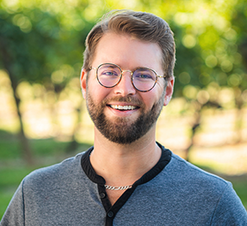
Philip Brown, Winemaker
Phillip grew up in Campbellville, ON, an agricultural community nestled in the Niagara Escarpment and surrounded by conservation areas. Growing up, his father worked in the restaurant industry with a focus on wine and food pairings. It was customary to have meals accompanied by quality wines, that Phillip would occasionally be given an opportunity to smell (and sometimes taste). His father’s passion for wine and extensive cellar nurtured Phillip’s curiosity, and that curiosity grew to a strong desire to understand more about the world of wine.
Before the age of 19, Phillip joined Niagara College’s Winery and Viticulture Technician program. In 2010, he was introduced to the Arterra family (previously known as Vincor) when his work/study program placed him at Inniskillin Estate as a cellar hand. The following Summer, Phillip worked in Prince Edward County at Stanners Vineyard, a small organic winery, where the Winemaker and owner mentored him through his methods and practices in organic, minimal intervention winemaking.
In 2015, Phillip made the leap from a small to large-scale winery when he moved to New Zealand and worked at Drylands winery in Rapaura, a subregion of Marlborough. Here, Phillip managed a team in the cellar through an intensive harvest, seeing roughly 2,400 tonnes of fruit a day.
His passion and hard work led him to twelve years at Jackson-Triggs Niagara Estate, with two of those as Estate Winemaker. His appointment with Kew Vineyards is the perfect fit as he takes his expertise in sparkling winemaking with him. In Niagara, Phillip has fallen in love with Pinot Noir and Chardonnay. These multifaceted varietals make crisp and vibrant traditional method sparkling wines, as well deeply complex and nuanced table wines that are a beautiful expression of Niagara’s terroir. “I also must shout out Riesling,” said Phillip. “Here in Niagara, this grape always carries mouth-watering acidity which makes it such a refreshing wine to enjoy, dry or sweet.”
Outside of work and wine, Phillip is a lover of the great outdoors and enjoys back woods camping and hiking with his dog. He loves to cook and is working on his green thumb with a small veggie patch in his backyard. Phillip is also a self-proclaimed nerd, and has found a community of like-minded individuals in the wine industry who enjoy getting together for board games and D&D (that’s Dungeons and Dragons) with a glass of wine or two.
Why We're Cool
Kew Vineyards is one of the pioneers of cool climate Chardonnay growing here in the Niagara region, with the Viticulturist Hermann Weis planting some of our original Chardonnay vines on the Kew property back in 1978! That's over 40 years of cool Chardonnay. These vines are growing in a goldielock zone of the Niagara benchlands, just outside the town of Beamsville. The vines are beautifully situated with just the right elevation, distance from the lake and lovely dolomitic limestone soils to grow and prosper. We here at Kew are very thankful to Hermann's foresight with planting these vines and are honoured to get to craft delicious wines from the fruits of his labour.
Leaning Post Wines
Niagara, Canada

About Leaning Post Wines
A leaning post is what you find at the beginning of a row of grapes, anchoring the wires that are the frame-work for growing grapevines. It is the beginning of an obsession to translate a time and place into liquid. Leaning Post wines take you to that beginning by finding small, unique plots of land in Niagara and putting them in bottle. Because after stripping away all the fancy buildings and high-tech equipment you are left with a place on this earth that grows wine unlike any other. When you taste that in a glass you just know it.
After many years as a Niagara winemaker, Ilya Senchuk and wife Nadia followed their dream to produce world-class, terroir-driven wines from unique plots of land across Niagara. Housed in a restored 1850s barn, Leaning Post epitomizes small-scale, artisanal winemaking that focuses on Riesling, Chardonnay, Pinot Noir, Syrah and Cabernet Franc. Our philosophy is to continue to find unique wines that truly show a sense of place.
Representative Biography
Ilya Senchuk, Owner & Head of Winemaking
Ilya Senchuk is the owner and Head of Winemaking for Leaning Post Wines. Originally from Winnipeg, Ilya followed his heart to pursue his Bachelors in Oenology and Viticulture from Brock University, graduating in 2003. Ilya truly can’t think of a better medium than wine, to express himself. It allows him to use his scientific and geeky side along with his artistic and creative side; add the connection to place, people and history and it is what he truly loves most. Ilya found his true calling early and built his career working for premium wineries in Niagara. He also honed his craft by working internationally in New Zealand.
In 2013, Ilya and wife Nadia opened Leaning Post Wines on Highway 8 in Winona, at the westerly edge of Niagara wine country. They planted the 11-acre Senchuk Vineyard to Pinot Noir and Chardonnay and restored a barn from the 1850s for the winery and tasting room. Throughout his career Ilya had always dreamed of creating terroir driven wines that showed a distinctive sense of place. His wine philosophy is an unrelenting search to find the best sources of grapes to create the best wine possible. Ilya believes that Cool Climate Chardonnay gives you the best of all worlds, “It shows the best of what wine has to offer, with richness, power and charm on one side and focus, subtlety and grace on the other.”
Why We're Cool
The area around our winery near the town of Winona is an unusual micro-climate. The distance between the Escarpment and Lake Ontario is only 1.6km, by far the closest in Niagara. The proximity between the lake and escarpment results in very breezy conditions and moderated temperatures throughout the growing season. The resulting wines have an amazing elegance and restraint combined with intense flavour concentration, power and acidity. This unique place has captivated all of us since we started our winery, pushing us into exploring the terroir nearby. Along with our estate “Senchuk Vineyard” we get Chardonnay from “Il Vigneto” vineyard about 500 metres from our home property, both of which are in Lincoln Lakeshore sub-appellation. We believe in exploring as many different terroirs in Niagara as we can with our Chardonnay program. As a result, we receive grapes from various vineyards in other Niagara sub-appellations to find the very best terroirs. For example, we source Chardonnay from “Wismer – Foxcroft Vineyard” in Twenty Mile Bench sub-appellation in Vineland, and we will continue to add vineyard sources to our portfolio if we feel the location, aspect and farming practices fit within our philosophy and are likely to give us superior wine.
All our Chardonnays can go through spontaneous (wild) primary fermentation in barrel, with spontaneous (wild) malo-lactic as well. Each of our vineyards is kept separate from picking and processing all the way through fermentation and aging. All our Chardonnays are released with low sulphite additions, and either a single very rough filtration or often no filtration at all. As a result, our wines will sometimes contain small amounts of sediment in bottle. Our goal is to allow the terroir of each vineyard site to shine through by using simple, minimal winemaking techniques. We feel this best captures the essence of the place the grapes were grown and translates that into bottle.

Divergence Wines
Niagara , Canada
About Divergence Wines
Divergence Wines was started in 2020 by winemaker and owner Jeff Moote with the objective of creating wines of great precision, authenticity, and quality that represent a unique take on the best of what Niagara has to offer. Small lot wines from great vineyards that are true to their origin and inspired by tradition, but not bound by it. Classic, but not necessarily mainstream.
Divergence is part of Collab Wine & Beverage, a collection of producers all sharing a common marketplace to bring craft Ontario beverages into the world. The wines are currently made at Marynissen Estates in Niagara-on-the-Lake, sourcing fruit from the best vineyards across Niagara.
Representative Biography
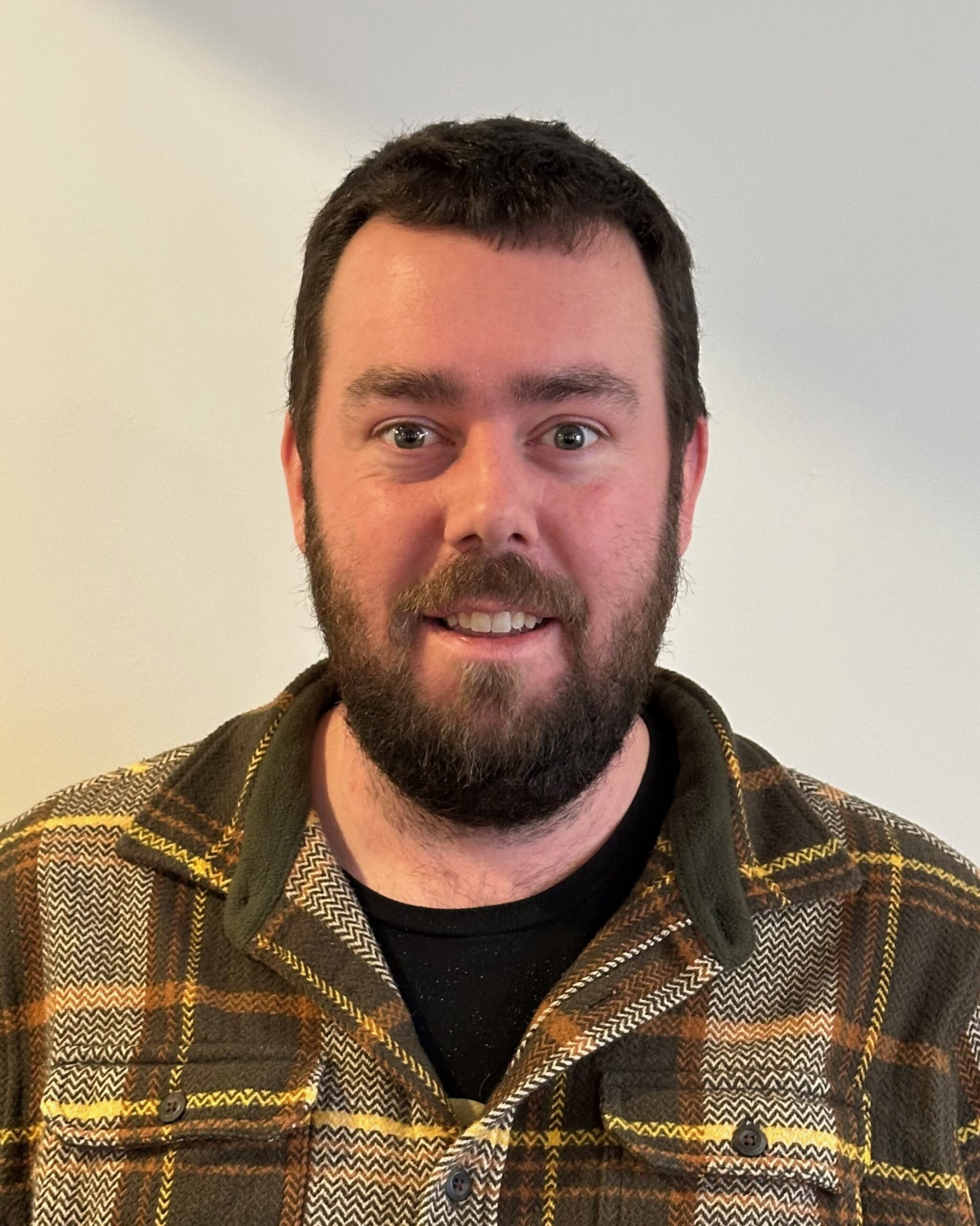
Jeff Moote, Founder and Winemaker
Jeff Moote is the founder and winemaker behind Divergence Wines.
Prior to graduating from the Cool Climate Oenology and Viticulture Institute’s Certificate in Grape and Wine Technology Program at Brock University, Jeff was an Engineer working in the chemical process industry.
Jeff has worked at well-known Niagara wineries before joining Vintegrated in a consulting winemaker role and launching Divergence. His time both inside and outside the wine industry has reaffirmed the “no compromises” ethos that continues to drive him.
“I am a huge fan of Cool Climate Chardonnay wines as they are the perfect communicator of both terroir and a winemaker’s signature. From traditional method sparkling to full on barrel fermented styles, the sense of place and stylistic intentions always come through.”
Why We're Cool
Cool climate Chardonnay is an important component of the Divergence brand. Single-vineyard Blanc de Blancs traditional method sparkling was the first Divergence wine to be conceived and is at the heart of the portfolio. Still wines have followed as I continue to access great vineyards and explore new blocks, clones, and styles.
These wines largely focus on the Lincoln Lakeshore sub-appellation with vineyards such as Grimsby Hillside Vineyard, Mio Vineyard, and (formerly) Hughes Vineyard as I feel this area offers such a generous expression of the variety.
Niagara offers such a great climate for making all of these wine styles, with great balance between freshness and ripe flavours each year. We get incredible vintage variation and it comes through in the wines, but Chardonnay seems to handle the variation the best of all varieties and make compelling wines regardless of the vintage.
Domaine Le Clos Jordanne
Ontario, Canada
About Domaine Le Clos Jordanne
One of the furthest great bench vineyards from the lake, some five kilometres from the hustle and bustle of the QEW highway and the Jordan Harbour, the Le Clos Jordanne Vineyard sits quietly on the Jordan Bench, surrounded by its own Clos of Carolinian forest.
The challenge was to proceed to look for THE best plot of land within the Le Clos Jordanne vineyard to make Le Grand Clos. Similar to the Grand Cru tier in Burgundy, we are doing a ‘vineyard-within-a-single vineyard’ approach. After several years of listening to the wines, and walking the vineyards, it became obvious that the western side of Le Clos Jordanne gave the wines of the most striking potential for showing, breeding silkiness, length and longevity. Fermented with indigenous yeasts and long-aged in barrel before bottling, the cuvée is tasted meticulously, barrel-by-barrel, with only the most ‘transparent’ barrels retained … those that support but ‘stay out of the way of the terroir.’
Our mission here is to home in on the ‘filet mignon’ of the Clos Jordanne vineyard. Simply our finest expression of the Jordan bench Terroir.
Representative Biography
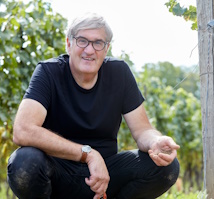
Thomas Bachelder, Winemaker
Thomas Bachelder is an internationally recognized Canadian winemaker - and Domaine Le Clos Jordanne’s original founding winemaker - with a specialty in the production of cool-climate Pinot Noir and Chardonnay. His terroir-revealing wines with distinct, complex minerality helped to propel a young Niagara region into the global spotlight in the mid to late 2000s. His efforts were instrumental in showcasing how old world, Burgundian winemaking techniques employed on new world terroir - with minimal intervention - could produce exceptional wines.
Originally from the dairy farming belt east of Montreal, Quebec, Thomas grew up on his family’s farmland, helping to foster a love of agriculture from a young age. In 1985, Thomas was first introduced to winemaking when he received a “Beaujolais-style” home winemaking kit for Christmas. Originally interested in winemaking as a hobby, it was his honeymoon trip to Burgundy with his wife, Mary Delaney, that inspired him to become a full-time winemaker.
His career began in 1992 when he moved to Burgundy to work as a winemaking assistant for two esteemed Domaines, Domaine de la Créa, Bligny-lès-Beaune and Domaine Marius Delarche, Pernand-Vergelesses. Following this and a stint in Oregon, he was invited back to Burgundy to join the historic Château Génot-Boulanger where he was able to introduce some new world winemaking notions, into one of the old world’s most traditional villages. A move back to Oregon in the late 90’s saw Bachelder create some of the greatest Pinot Noirs in the state during four vintages at Lemelson Vineyards.
In 2003, Bachelder became the founding winemaker of Le Clos Jordanne. Enamored by the Burgundy region, Bachelder had been hesitant about making wine in Ontario, but he quickly fell in love with the unique nature of the project and the limestone-laced, micro-climate of the Jordan Bench. Le Clos Jordanne became a passion project and he viewed it as an incredible opportunity to put Canada on the winemaking map.
Leveraging a decade’s worth of experience obsessing over the marriage of new and old world techniques, Bachelder and Le Clos Jordanne won almost immediate attention and praise. In 2009, the 2005 Claystone Terrace Chardonnay generated global recognition after winning first place in the Judgement of Montreal competition. It was only the second wine he had produced at Le Clos, earning Bachelder Winemaker of the Year in that year’s Ontario Wine Awards.
Bachelder left Le Clos Jordanne in 2010 and continued to produce world-class examples of cool-climate wines in Oregon, Burgundy and Niagara, under his own label, Bachelder. He recently added a new varietal, Gamay, to his portfolio. His technique continues to showcase the personality of the region, with little winemaker intervention and extended time in the barrel. Now, Bachelder will return to execute the rebirth of Domaine Le Clos Jordanne, bringing with him his immense knowledge of this particular vineyard, his passion for the region and his unique, terroir-focused style.
Why We're Cool
The Jordan Bench, located within the greater VQA TWENTY-MILE BENCH Appellation – is a microclimate that benefits not only from having its roots in the Dolomitic limestone of the ‘Bench,’ but also from the altitude and distance from the lake, a slow-ripening site with long hang-time that produces wines that are wines cool and mineral.
Lailey Winery
Niagara-on-the-Lake, Canada
About Lailey Winery
Located moments from the historic Old Town of Niagara-on-the-Lake, Lailey Winery has been a pioneer in artisan, estate-grown winemaking for more than forty years, with grapes planted back in the 1970s. Close to the steep brink of the mighty Niagara Gorge, we cherish regional authenticity and focus on bringing wine lovers the best of Niagara with minimal intervention in the winemaking process.
We grow grapes in two VQA appellations; Stonebridge Vineyard in Four Mile Creek VQA and Lailey Vineyard in Niagara River VQA.
A great wine transfers a sense of place when first tasted. This sense of place is something you preserve, not build. Our vineyard team grows our grapes by preserving their relationship with the soil, our winemaking team preserves the flavours that are entrusted to them.
Building upon our low yield, small batch, single vineyard principles, our Stonebridge series also employs an especially minimal intervention approach to winemaking that includes wild fermentation using only indigenous yeast. This process results in even more complex flavours and textures in these wines and the truest expression possible of our vineyard terroir.
Representative Biography
Faik Turkman, Owner & Vintner
Choosing to make his love for wine into a lifelong career, Faik, after significant research into international fine winemaking regions, chose Canada’s Niagara-on-the-Lake to immerse himself in a quest to achieve authentic, quality viticulture and winemaking. Inspired by the excellence of the world’s great wine producers, and invigorated by nature’s day-to-day challenges, Faik has surrounded himself with experts in their areas and is developing Stonebridge, and farming Lailey, to produce outstanding grapes for the production of wines of uncompromised quality.
About Ann Sperling and Peter Gamble, Winemakers
Often referred to as the “power couple” of the Canadian wine industry, the team of Peter Gamble and Ann Sperling have long pursued the pinnacles of wine quality in Canadian vineyards and wineries.
Ann, following her upbringing on her family’s Okanagan Valley vineyard, and throughout a distinguished career of winemaking and viticultural accomplishments, innately turned to the soil for the character and complexity of her wines. Acknowledged as a Canadian pioneer of organic and biodynamic viticulture as far back as the ‘90s, ‘terroir’ was at the centre of her artisan philosophy long before it became a buzzword in modern winemaking. Ann provides the “grounding” for this vineyard focussed team.
Renowned, too, for her head winemaking roles over the years at Malivoire Wines, Southbrook Vineyards and Sperling Vineyards, Ann’s been recognized through such awards as the 2004 Ontario Winemaker of the Year, the 2012 International Winery of the Year (Intervin), and the 2021 Riedel International Winemaker of the Year.
Peter, a lifetime wine industry professional whose career has encompassed roles as a distinguished professional winemaker and consultant, an internationally recognized wine taster and judge, and the founding Executive Director of the VQA, has long worked alongside Canada’s most passionate winemakers to achieve greater heights with our finest appellation wines.
Since 2000, Peter’s company has been dedicated to providing expertise in a range of areas critical to the successful establishment of ultra-premium winemaking operations. Along with international work, Peter was the lead consultant in the establishment of several significant Canadian winery projects including, in Niagara-on-the-Lake, Stratus Vineyards and Ravine Vineyards; and in Nova Scotia, Benjamin Bridge Vineyards and Lightfoot & Wolfville Vineyards. Peter was the inaugural recipient of both the Tony Aspler Award for Contributions to the Ontario Wine Industry and the Karl Kaiser Winemaker Emeritus Award for Outstanding Services to the Canadian Wine Industry.
With the purchase of a top-flight ancient Malbec planting in Mendoza, Argentina, in 2008, Ann and Peter broadened their company’s winemaking activities …but Niagara remains their cherished home base, where they focus on prestige wineries in their start-up phase.
Lailey Vineyard / Stonebridge Vineyard
Involvement began with Stonebridge in 2017 and grew to encompass the revitalization of the Lailey Vineyards operation with its purchase by Stonebridge in 2021. Peter and Ann oversee all winemaking and viticulture for both vineyards and, working with Assistant Winemaker Connor Book and vineyard contractor Phil Clarke, are excited about the tremendous potential of the two very different terroirs.
Why We're Cool
Our Stonebridge vineyard is located in the Four Mile Creek sub appellation of Niagara-on-the-Lake. Growing on the blend of Lake Iroquois sediments and glaciolacustrine clay. The Queenston bedrock shale that sits below consists of a sequence of ancient rock beds or strata, originating from over 500 million years ago as marine sediments in a warm shallow inland sea.
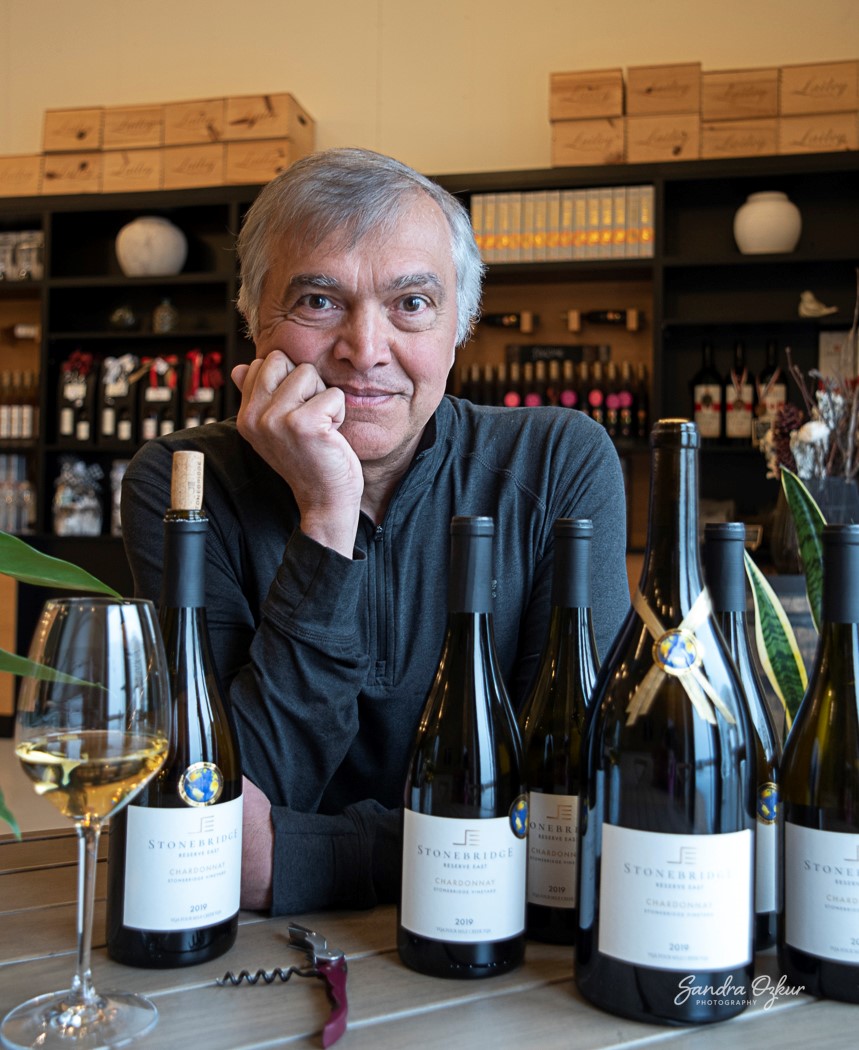
Stonebridge builds on diversity of clones, rootstock and microclimate, adding elegant complexity and structure to our Chardonnay. Our Chardonnay clones (95, 96, 548 & 76) are all hand harvested and fermented ‘clonally separate’ allowing us to work with each individually. In our East Reserve Chardonnay from 2019, we used only a single clone (76), whereas our flagship 2019 Stonebridge Chardonnay includes all four.
Our team works with practices that build on soil health and low yields, which allows for maximum expression of terroir in the complex and balanced fruit from our vineyard. In central Niagara-on-the-Lake and the hottest and windiest part of Four Mile Creek appellation, most of our 40 acres of this estate is dedicated to producing some of the best Chardonnay and Cabernet Franc. Cool nights extend the hang time and preserve the acidity of the fruit, building complexity in our wines.
Thank you to the i4C 2026 Presenting & Grand Cru Sponsors